Learn About Us

My photo
Winter Haven, Lakeland, Davenport, Bartow, FL, United States
We offer the latest technology in diagnostic studies, our office is the only one in Polk County to offer PSSD testing for peripheral nerve problems.
Showing posts with label foot pain davenport. Show all posts

Friday, March 20, 2009

How do I fit a new pair of shoes?


Dr’s. RESPONSE:  Shoes are an important component of our attire that many people take for granted.  Shoes are quite important and fitting. A new pair of shoes is not as simple as buying what you want off the shelf and breaking them in. 

Our feet change throughout the day.  In the morning, our feet are at their smallest because they have been resting all night long while your body has been sleeping.  When we first get up in the morning, our feet also begin their long day.  As the day progresses, our feet begin to swell.  This is due to repetitive usage as well as the effects of gravity which pull more fluids towards our feet.  Also, when our feet are hot, they begin to sweat.  This obviously tends to occur more as the day goes on.  

So what is the true way to find a pair of shoes?  First of all, when you try on a pair of shoes, you must try them on at the end of the day, when your feet are their largest.  Because our feet swell, those shoes that we try on in the morning might fit just right but may be tight towards the end of the day.  Also, be sure to try on both pairs of shoes.  No two shoes or two feet are exactly alike.  Therefore, the effort must be made to try on both pairs of shoes to ensure that there are no fitting issues.  Sometimes, inner seams can irritate feet, shoe tongues can be bothersome, and slip in pads can be poorly manufactured.  Also, if you know that one foot is bigger than the other, wear shoes that fit the largest foot, not the smaller foot. 

Also, a knowledgeable shoe salesman, which are becoming harder and harder to find these days, should use a Braddock device.  If you recall from childhood, this is that funny oval metal thing that you used to stand in to measure your foot size.  These are separate ones for men and women.  Your foot should be measured while you are standing.  As you stand, your foot stretches to its full length as the arch of your foot slightly flattens.  Another way to gauge the correct size is that when trying on a new pair of shoes, stand up and kick your heel all the way to the back of the shoe.  While standing, you should be able to press a full thumb’s width from the tips of your toes to the shoe tip.  If it is less than that width, those shoes are too small. 

Another important tip to remember is that, in general, dress shoes are one full size smaller than sneakers.  So if you wear are 13 sneaker, your dress shoes should be a size 12.  Also, for women who have had children, the general rule is that for every child you have, your shoe size may increase by one half shoe size.  Finally, a good supportive shoe is one that will not bend easily from tip to heel.  There should be enough resistance within the sole of the shoe to prevent this.

Central Florida Foot & Ankle Center, LLC
101 6th
 Street N.W.
Winter Haven, FL 33881
Phone: 863-299-4551

http://www.flfootandankle.com

What is a gout?


A swollen, red joint in the big toe is considered a hallmark sign of gout?

True or False

Dr.’s RESPONSE:  This is absolutely true.  In fact, it even has its own name: podagra.  Gout is a recurrent acute arthritis that affects peripheral joints, most notably the big toe joint.  The condition is due to a build up of monosodium urate crystals in and around joints and tendons. Highly saturated body fluids condense and then crystallize.  These crystals cause severe pain in the affected joints.  It’s almost as if there a tiny needles in the joints.  With each movement, those small needles scrape against the tissues, causing severe pain.  Acute gouty pain is unmistakable.  Patients often describe it as though they cannot even bear to have bed sheets touch their foot.  Another common complaint is that the air conditioner blowing on the affected foot is extremely painful.  Other symptoms include sudden onset of single joint pain, low grade fever, 20:1 male to female ratio, crunchy tophi formation, and a red hot swollen big toe joint. 

Acute gout may become chronic and deforming.  Chronic gout causes destruction of the joint edges and actually erodes away portions of bone.  It can also lead to the accumulation of gouty tophi, a substance created by the body that resembles shards of glass mixed with cottage cheese.  These accumulations can develop in the feet, hands, on the elbows, knees, ears, and even the tip of the nose.  

Gout classically begins in the morning or early evening and tends to occur in previously damaged joints.  The well accepted theory is that gout crystals have an aversion to warm parts of the body.  But they also need a large enough area to accumulate.  Therefore, the big toe joint, far away from the main heat source of the body and yet large enough to allow urate crystal deposition to occur is the ideal location for these crystals to condense.  Many factors contribute to the formation of these crystals, with diet being a major contributor. Avoid organ meat, lard, sardines, alcohol (especially red wine), diuretics, and certain medications. 

There are basically two kinds of gout which are the “under-excretors” and the “over-producers.”  Under-excretors are those individuals that can not clear enough of the crystals from the blood stream via their kidneys.  This is the more common type of gout and it is also known as renal gout.  The other, less common type is known as metabolic gout.  This is due to a defect in genetic enzymes.  Both are treated with medications and lifestyle changes.

Central Florida Foot & Ankle Center, LLC
101 6th
 Street N.W.
Winter Haven, FL 33881
Phone: 863-299-4551

http://www.flfootandankle.com


Monday, March 16, 2009

Barefoot Running


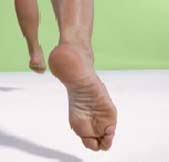
The barefoot lifestyle and barefoot running is a trend gaining popularity in the running community.  Opinions on barefoot running vary greatly, from “Absolutely Not” to “Absolutely No Other Way”. 


            The barefoot community claims that running barefoot improves the runner’s form, and eliminates problems like knee and hip pain.  This is due to a change in form.  When wearing running shoes, which typically have a thick padded cushion in the heel, striking the ground with the heel first sends shock all the way up the leg.  This force is largely absorbed by the knee, as well as the hip and back, which can be transferred to chronic pain.  Barefoot running eliminates the option of heel striking, forcing the barefooter to land on the balls of the feet, with the feet lined up directly underneath the hips.  This allows the force to be displaced more evenly, avoiding common running injuries.

            Many claim that the barefoot lifestyle is the only way to go.  Advocates of a barefoot lifestyle claim that it is the only true way to feel the ground, and that keeping your foot in a shoe all day is bad for the mind and the spirit.  Barefoot running expands into barefoot walking, even barefoot driving!

            But is the barefoot lifestyle a wise decision?  The opinion on the other side of the spectrum is that barefoot running and walking can lead to serious health problems.  Imagine walking around barefoot all day with an “improper” form, striking with your heel.  This would lead to some serious heel pain.  Also, a barefoot lifestyle offers no protection against the elements, and no protection against debris that may be on the ground.  Puncture wounds on the foot can lead to serious infections. 

            Still, even with the obvious thought that a barefoot runner’s feet would get chewed up by the elements and terrain, barefoot running has a significant following.  In fact, many bare footers prefer a rough terrain like asphalt to a soft terrain like grass or sand!  There has been much reporting on the barefoot lifestyle, including this article found in New York Magazine, which discusses the idea of shoes wrecking our feet by wearing shoes.  There are websites devoted to a barefoot lifestyle, like the Society for Barefoot Living and RunningBarefoot.org.

            While many may shudder at the thought of walking to the store with no shoes on, or running on a city sidewalk barefoot, there are those who would have it no other way.  Which side of the fence are you on? 

Central Florida Foot & Ankle Center, LLC
101 6th
 Street N.W.
Winter Haven, FL 33881
Phone: 863-299-4551

http://www.flfootandankle.com

Wednesday, February 18, 2009

Are Running Shoes Good for Walking?

As a general rule, running shoes are good for walking, but walking shoes are not good running shoes. Podiatrist Bob Baravarian, Chief of Foot and Ankle Surgery at Santa Monica-UCLA Medical Center and OrthopedicHospital, says that walkers should look for a pair of comfortable, easy fitting shoes that combine stability, cushioning, and some flexibility to correct stride problems. The right shoes can prevent or alleviate the three most common overuse injuries walkers suffer: plantar fasciitis (pain in the heel), Achilles tendonitis (pain from the back of the heel up the calf), and posterior tibial tendonitis (sore arch or inner ankle).

DR.'S RESPONSE:  Remember that when you go shopping for shoes to do it later in the day. This is because as we walk during the day and because of dependency, our feet tend to swell as the day progresses.  Therefore, you should buy your shoes when your feet are their biggest. Also, there is a great disparity in sock thickness.  So when you go shopping, you should wear socks that you would normally wear with those types of shoes. check out our online store for shoes

Central Florida Foot & Ankle Center,LLC
101 6th
 Street N.W.
Winter Haven, FL 33881
Phone: 863-299-4551

http://www.flfootandankle.com